The Role and Utility of the $YALA Token

Let's dive into the $YALA token and its role in the Yala ecosystem.

$YALA is essential as it contributes to the well functioning of the protocol through recapitalization, mechanisms for maintaining systemic stability, and eventually governing the platform. We'll explain how $YALA functions and why it's so important for the Yala ecosystem.

How Does the Yala Protocol Work?

Collateralized Debt Positions (CDPs)

CDPs allow users to generate $YU by locking up collateral assets such as Bitcoin and other Bitcoin-native assets. Here's how it works:

  • Depositing Collateral: Users create their own Vault, which acts as a personalized account for managing their collateral and debt. The exact process depends on the operational mode they choose:
    • Lite Mode: In this user-friendly mode, Yala’s automated system handles most of the backend processes. Here, YBTC (the tokenized representation of Bitcoin) is automatically generated and deposited into the smart contract on behalf of the user.
    • Pro Mode: For advanced users, this mode offers greater control. Users manage the process themselves, directly interacting with the protocol to deposit their YBTC into the smart contract.
    • Institution Mode: Tailored for institutions and large BTC holders, offering maximum control by keeping BTC locked in user-managed Bitcoin wallets with mainnet-level security.

You can read more about it in this article.

  • Generating Stablecoins: Once the collateral is locked, users can generate $YU, which is soft-pegged to the US dollar. $YU can be used for various financial activities, such as payments, savings, or collateral management. The amount of $YU that can be minted is determined by a Loan-to-Value (LTV) ratio, initially set by the Yala Foundation that will later transition into System Governance by the $YALA holders, ensuring that the system remains adequately collateralized and stable.
  • Maintaining Collateralization: The Yala Foundation has also initially set a liquidation threshold to maintain the peg. This means that the value of the collateral must always be higher than the value of the stablecoins to maintain the system's stability. If the collateral value drops below a certain threshold, the CDP may be liquidated to cover the outstanding stablecoin debt. In this Medium article, you can read about different DeFi strategies.

What is the $YALA Token?

The $YALA token is a cornerstone of the Yala ecosystem combining reward, governance, and security functionalities. It incentivizes participation, enhances system stability, and offers holders influence over the protocol's evolution.

Over time, $YALA is designed to transition from a rewards and utility token into a robust governance tool, ensuring the protocol remains adaptive, secure, and community-driven.

$YALA is designed to serve multiple functions within the ecosystem, making it indispensable for the platform's operation. 

1. Stability Pool Rewards

Participants in the Stability Pool deposit $YU to absorb debt from liquidated vaults. In return, they are rewarded with $YALA tokens, along with a portion of the liquidated collateral and stability fees. 

This incentivizes users to maintain the platform’s liquidity while ensuring its stability during market fluctuations.

Let’s break down how this works, including the proportional distribution of collateral to participants.

2. How Do Rewards Work?

  1. Debt Repayment via Stability Pool:When a vault is liquidated due to its Individual Collateral Ratio (ICR) falling below the Minimum Collateral Ratio (MCR), the debt of the vault is repaid using $YU deposited in the Stability Pool. This ensures the protocol remains solvent and stable.
  2. Collateral Redistribution:Once the debt is repaid, the corresponding collateral from the liquidated vault is distributed among Stability Pool participants. The distribution is proportional to the amount of $YU each participant has contributed to the pool.For example:
    • If a vault’s debt of $666.67 is repaid using the Stability Pool, the corresponding collateral worth $666.67 is distributed.
    • A depositor who owns 10% of the total $YU in the Stability Pool would receive 10% of the collateral, equating to $66.67.
  3. Additional Rewards:On top of collateral distribution, Stability Pool participants earn $YALA tokens as an incentive for maintaining liquidity. Stability fees collected from the liquidated Vault further reward participants, making this process financially attractive.

Illustrative Example

  • Vault Owner: Deposits $1000 worth of Bitcoin as collateral and borrows $666.67 in $YU (MCR of 150%).
  • Price Drop: Bitcoin’s value decreases, and the collateral drops to $800, resulting in an ICR of 120%, triggering liquidation.
  • Liquidation Process:
    1. The $666.67 debt is repaid using $YU from the Stability Pool.
    2. Collateral worth $666.67 is redistributed to pool participants proportionally. A depositor holding 10% of the pool receives $66.67 in Bitcoin.
    3. Any remaining collateral ($800 − $666.67 = $133.33) is returned to the vault owner as surplus.
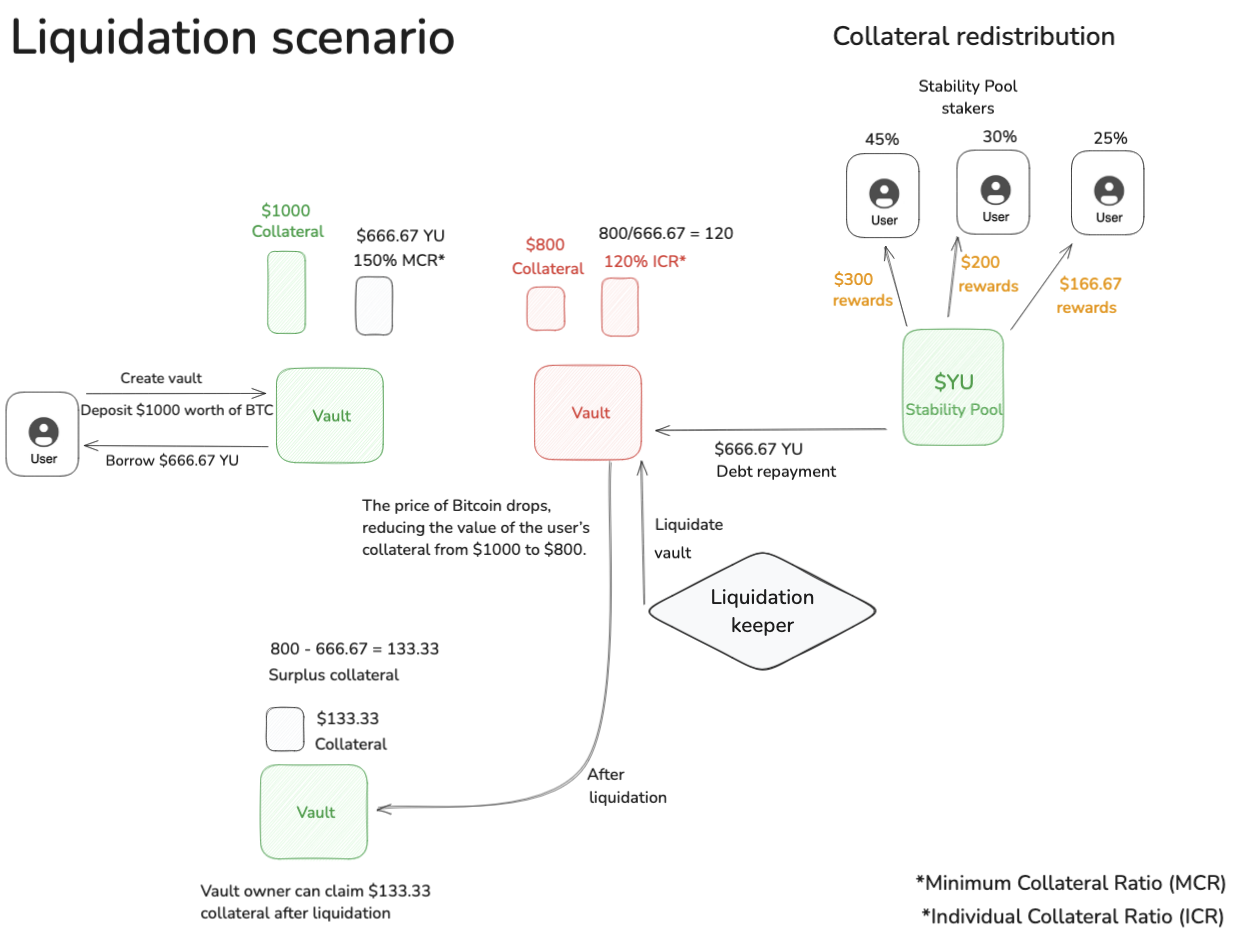
Liquidation Reward Distribution

What Happens if the Stability Pool is Insufficient?

In scenarios where the Stability Pool cannot fully cover the debt, the remaining debt and collateral are redistributed proportionally across active vaults. This ensures that the system remains solvent, even in extreme situations.

3. Governance

As the protocol matures, $YALA becomes a vital governance token, empowering holders to:

  • Vote on Key Decisions: Influence protocol parameters such as collateral ratios, fee rates, and stability mechanisms.
  • Propose Upgrades: Advocate for protocol improvements that ensure long-term competitiveness and address user needs.
  • Gauge Weight Voting: Direct $YALA emissions through holding $veYALA, ensuring resource allocation aligns with the community’s priorities.

By distributing governance power to the community, Yala ensures transparency and aligns its evolution with the interests of its users.

4. Crypto-economic Security

$YALA tokens play a crucial role in maintaining the platform’s cryptoeconomic security:

  • Bridge Security: Stake $YALA to delegate and secure nodes on Yala’s Notary Bridge.
  • Solver and Relayer Networks: Stake or restake $YALA to support the solvers or relayers network, ensuring seamless operations within Yala’s Unified Liquidity solution.
  • Decentralized Verifier Networks (DVN): Stake or restake $YALA to secure $YU’s DVN, leveraging the decentralized infrastructure of LayerZero.

Conclusion

In this blog post, we've explored the role of the $YALA token. From its critical functions in governance to earning rewards for providing system stability, $YALA plays an important role in the Yala ecosystem. As Yala continues to innovate and grow, the token will play a pivotal role in its success, offering a robust and decentralized financial solution for users worldwide.

To stay updated on the progress of our indexer technology, feel free to follow our developments on GitHub.

Keep an eye on Yala as we keep pushing the boundaries of innovation and shaping the DeFi space's future.

About Yala

Yala is building a liquidity layer to unlock Bitcoin’s untapped yield across DeFi and RWAs. Users can deposit BTC and access seamless liquidity, enabling efficient capital movement and yield opportunities across ecosystems, chains, and protocols.

Website | Twitter | Telegram | Discord | Medium | Docs

Yala Updates: January

January kicked off with strong momentum for Yala, with 1.5 million testnet wallets, significant product advancements, and continued community growth. Despite the volatility in the broader crypto market, we remain committed to long-term building and have reached key milestones.

In this update, we’ll cover:

  1. Yala Testnet V2 Success
  2. Yala Protocol Developments
  3. Community Initiatives
  4. Looking Forward to February

Testnet Success: 1.5M Yetis Strong

Testnet V1 launched on October 15th, followed by Testnet V2 on December 5th. Over the two months leading up to January 23rd, we reached impressive milestones:

  • 1.5M unique wallet addresses
  • $20B $YU minted
  • 736.6K transactions completed

A huge thank you to our 1.5 million Yetis—your enthusiasm and participation are the driving forces behind Yala’s success.

Yala Protocol Developments

Our development and product teams have been working tirelessly, integrating valuable feedback from our testnet users. We have introduced new modes and made significant progress toward delivering a more robust and comprehensive stablecoin solution. Below is an update on our key achievements:

🔹 Yield Farming: Development is complete, and we’ve entered the QA testing phase to ensure a secure and seamless user experience.

🔹 Institution Mode: In addition to Lite Mode and Pro Mode, we are introducing Institution Mode for institutional clients. This mode, powered by time-lock script technology, will offer specialized vault management and yield strategies for high-net-worth clients. We’ve partnered with third-party custodians like Anchorage and Cobo for seamless technology integration, enhancing security and user autonomy.

🔹 NFT Development: All NFT-related development work is now finalized, clearing the path for our upcoming NFT claim.

🔹 Convert & Peg Stability Module (PSM): The Convert function and PSM are complete, and we are now in the QA testing phase.

  • Convert Function: Allows users to swap USDC for $YU without slippage.
  • Peg Stability Module: Ensures $YU maintains its stable peg and enables Yala to invest in real-world assets (RWAs) using USDC without risking de-pegging.

🔹 Stability Pool: Development has started on the Stability Pool, a key feature to maintain the long-term health of the protocol. Users will be able to:

  • Stake $YU
  • Earn berries
  • Receive liquidation gains in YBTC
  • Earn token rewards in $YU

This pool will play a crucial role in the stability and resilience of the protocol.

Community Growth & Initiatives

In January, we strengthened our focus on community education, offering insights into Yala from multiple perspectives. We also maintained a strong presence within our community, actively engaging with members and inviting partners to foster meaningful discussions.

One of our key initiatives was the publication of an article outlining Yala’s security measures, detailing how we safeguard user assets at every stage. Whether you are a retail investor, institutional holder, or experienced trader, Yala provides tailored security solutions to meet diverse needs:

🔹 Pro Mode: Smart contract monitoring tracks BTC and YBTC balances to ensure transaction consistency and minimize errors.

🔹 Institution Mode: Institutions maintain full custody of their BTC through Pay-to-Witness-Script-Hash (P2WSH) transactions, ensuring only the account owner can access the funds.

🔹 Lite Mode: Designed for retail users, this mode provides sustainable yields with minimal risk.

📖 Read the full article here:

Securing Your Bitcoin: Ensuring Safety for BTC Deposits
In this article, we’ll explore how Yala ensures the safety of BTC deposits across its Lite, Institution, and Pro Modes.

Our core team has been actively engaging with the community through various platforms.

🎙 KT shared insights on BTC ETFs during a discussion on @themass space, addressing the risks of market manipulation and how retail investors could get trapped buying at the top in a less organic market.

🔥 Yala’s Bitcoin Liquidity Series continued to thrive, featuring insightful conversations with StakeStone, Berachain, and more.

💡 Berachain shared its journey from Ethereum to becoming a BTCfi hub, emphasizing that:
"Bitcoin is a massive but underutilized opportunity."

As we move into February, we remain committed to expanding educational content, fostering engagement, and strengthening the Yala ecosystem.


What’s Next: February

With January laying a strong foundation, February promises to be another milestone month for Yala. We are gearing up for the launch of Testnet V3.

Testnet V3 will introduce a major new feature: the DeFi Marketplace.

  • Users will be able to utilize $YU across Yala’s partner DeFi projects while earning points from Yala.
  • This initiative aims to drive real-world usage of $YU across diverse applications, furthering our mission to bring Bitcoin’s liquidity across blockchains.

January was just the beginning. We’ll continue building, innovating, and moving closer to our vision for Yala.

Stay tuned!

Join the Yala Community

Yala is building a liquidity layer to unlock Bitcoin’s untapped yield across DeFi and RWAs. Users can deposit BTC and access seamless liquidity, enabling efficient capital movement and yield opportunities across ecosystems, chains, and protocols.

Website | Twitter | Telegram | Discord | Docs

Safeguarding Stability: A Deep Dive into Yala's Liquidation Process

Yala's liquidation process empowers users while safeguarding the protocol. Through components like the Stability Pool and the incentivized participation of liquidators, the system effectively manages collateral and debt to protect against market volatility.

In this blog, we’ll explore how Yala’s liquidation mechanism works, the incentives it provides, and the role of the $YALA token in ensuring a resilient ecosystem. Whether you’re a borrower, Stability Pool contributor, or liquidator, Yala’s process offers a clear, user-focused path to maintaining financial health.

Let’s dive in.

Collateral & Debt Management

At the core of Yala’s system is the ability for users to create vaults, which act as personal smart contracts for collateralized borrowing. By depositing Bitcoin into these vaults, users can mint Yala’s stablecoin, $YU. This process allows Bitcoin holders to unlock the liquidity of their assets without selling them, preserving exposure to Bitcoin’s price movements while accessing DeFi opportunities.

Creating vaults: The Basics

  • Collateralization: Users create their own Vault, which acts as a personalized account for managing their collateral and debt. The exact process depends on the operational mode they choose:
  • Lite Mode: In this user-friendly mode, Yala’s automated system handles most of the backend processes. Here, YBTC (the tokenized representation of Bitcoin) is automatically generated and deposited into the smart contract on behalf of the user.
  • Pro Mode: For advanced users, this mode offers greater control. Users manage the process themselves, directly interacting with the protocol to deposit their YBTC into the smart contract.
  • Minting $YU: Once collateral is deposited, users can mint $YU stablecoins up to a specific limit, determined by the Loan-to-Value (LTV) ratio. This ratio ensures that the amount of $YU borrowed does not exceed the value of the collateral beyond safe thresholds.

Minimum Collateral Ratio (MCR): A Safety Net

To maintain the system’s stability, the Yala Foundation sets a Minimum Collateral Ratio (MCR), which defines the minimum required collateral value relative to the debt (minted $YU). For instance:

  • If the MCR is set at 150%, it means the value of the collateral must always be at least 1.5 times the value of the minted $YU.
  • Falling below this threshold makes the Vault eligible for liquidation, a necessary step to prevent debt and ensure the stability of the system.

Example Scenario: Managing Collateral and Debt

Imagine a user, Alice, who creates a Vault:

  1. Alice deposits $1,000 worth of Bitcoin as collateral.
  2. She mints $YU stablecoins worth $666.67, maintaining an Individual Collateral Ratio (ICR) of 150%, meeting the MCR requirement.

Now, let’s say the price of Bitcoin drops:

  • The value of Alice’s collateral decreases to $800, lowering her ICR to 120% (800/666.67).
  • Since her ICR has fallen below the MCR of 150%, her Vault becomes eligible for liquidation to protect the system.

By adhering to the MCR and monitoring the ICR of each Vault, Yala ensures that the system remains over-collateralized, safeguarding the stability of $YU and the protocol as a whole. This collateral management framework creates a reliable and secure environment for users while minimizing systemic risks.

Liquidation Scenario

The Role of the Stability Pool

The Stability Pool is a cornerstone of the Yala protocol, ensuring the system remains stable even during market volatility. It acts as a safeguard, absorbing bad debt from under-collateralized vaults while redistributing collateral to those who support the system.

What is the Stability Pool?

The Stability Pool is a reserve of Yala’s stablecoin, $YU, contributed by users who wish to support the protocol’s stability. This pool is a key mechanism for managing liquidations and maintaining the peg of $YU to the US dollar.

  • Depositors' Role: Users deposit their $YU into the Stability Pool, enabling the protocol to utilize these funds during liquidations.
  • Incentives for Participation: Stability Pool depositors earn rewards in return for their contributions. These rewards include:
    • $YALA Tokens: As incentives for maintaining liquidity.
    • Collateral from Liquidated vaults: When a Vault is liquidated, its collateral is distributed to Stability Pool participants based on their share in the pool.

How Does the Stability Pool Work During Liquidations?

When a Vault’s Individual Collateral Ratio (ICR) falls below the Minimum Collateral Ratio (MCR), it becomes eligible for liquidation. The Stability Pool plays a pivotal role in this process:

  1. Absorbing Debt:
    • The debt of the liquidated Vault is repaid using $YU from the Stability Pool. This ensures that the protocol remains solvent and prevents the creation of unbacked $YU.
  2. Redistributing Collateral:
    • In return for covering the debt, the protocol distributes the liquidated Vault’s collateral (Bitcoin) to Stability Pool depositors. This collateral is allocated proportionally based on each depositor’s share of the pool.

How Liquidation Works

Liquidation is a critical mechanism in Yala’s protocol, ensuring the system maintains stability and solvency even when vaults fall below the required collateralization thresholds. This process protects the platform, depositors, and the broader ecosystem by efficiently addressing under-collateralized positions.

Trigger Mechanism

Liquidation is triggered when a Vault’s Individual Collateral Ratio (ICR) falls below the Minimum Collateral Ratio (MCR) set by the Yala Foundation.

  • ICR Defined: The ICR is the ratio of a Vault’s collateral value to its outstanding debt. For example, an ICR of 150% means the collateral is worth 1.5x the borrowed $YU.
  • MCR Threshold: The MCR is the minimum required ICR to keep a Vault solvent. If a Vault’s ICR drops below this threshold, it becomes eligible for liquidation.
  • Keepers’ Role: External actors, known as keepers, monitor the system for under-collateralized vaults. When a Vault’s ICR falls below the MCR, keepers can initiate the liquidation process and are incentivized with rewards for their participation.

Debt and Collateral Flow

When a liquidation is triggered, the following steps occur to handle the liquidated Vault’s debt and collateral:

  1. Debt Repayment via Stability Pool:
    • The liquidated Vault’s debt (denominated in $YU) is fully repaid using funds from the Stability Pool.
    • This ensures that the protocol remains solvent and prevents the accumulation of bad debt.
  2. Collateral Redistribution:
    • In exchange for covering the liquidated debt, the corresponding amount of collateral is distributed to Stability Pool depositors in proportion to their share in the pool.

Redistribution Process

If the Stability Pool is insufficient to fully cover a liquidated Vault’s debt, the system implements a redistribution mechanism:

  • Remaining Debt and Collateral: Any leftover debt and collateral from the liquidated Vault are proportionally redistributed among active vaults in the system.
  • Proportional Allocation: The redistribution ensures that the system-wide solvency is maintained, even if the Stability Pool is depleted.

Surplus Mechanism

After the liquidated Vault’s debt is repaid, any remaining collateral (surplus) is returned to the original Vault owner:

Example: Liquidation Process in Action

Let’s break down a liquidation scenario for clarity:

  • Initial Vault Setup:
    1. Alice deposits $1,000 worth of Bitcoin into her Vault.
    2. She borrows $666.67 worth of $YU, maintaining an ICR of 150% (above the MCR).
  • Market Volatility:
    1. The price of Bitcoin drops, reducing Alice’s collateral value to $800.
    2. Her new ICR is $800 ÷ $666.67 = 120%, which is below the MCR threshold of 150%.
  • Liquidation Steps:
    1. Trigger: A keeper identifies Alice’s Vault as under-collateralized and initiates liquidation.
    2. Debt Repayment: $666.67 of $YU from the Stability Pool is used to repay Alice’s debt.
    3. Collateral Redistribution: Stability Pool depositors receive $666.67 worth of Bitcoin, distributed proportionally to their pool share.
    4. Surplus Return: The remaining $133.33 of Bitcoin (surplus) is returned to Alice.

The liquidation process ensures:

  • System Solvency: By repaying bad debt, the protocol remains stable and secure.
  • Incentivized Participation: Stability Pool depositors and keepers are rewarded for their contributions, encouraging active engagement.
  • Fair Redistribution: Any collateral surplus is returned to Vault owners, ensuring transparency and fairness.

Conclusion

Yala’s liquidation process is designed with both systemic stability and user incentives at its core. By combining a well-structured Stability Pool, fair collateral redistribution, and the multi-faceted utility of the $YALA token, the protocol ensures a balanced and robust ecosystem that protects participants and maintains financial security.

Yala’s approach not only safeguards the platform’s long-term stability but also creates opportunities for all participants—whether as depositors, Vault owners, or liquidators—to actively contribute and benefit from the ecosystem. 

To stay updated on the progress of our indexer technology, feel free to follow our developments on GitHub.

Keep an eye on Yala as we keep pushing the boundaries of innovation and shaping the DeFi space's future.

Join the Yala Community

Yala is building a liquidity layer to unlock Bitcoin’s untapped yield across DeFi and RWAs. Users can deposit BTC and access seamless liquidity, enabling efficient capital movement and yield opportunities across ecosystems, chains, and protocols.

Website | Twitter | Telegram | Discord | Docs

Securing Your Bitcoin: How Yala Ensures Safety for BTC Deposits

In this article, we’ll explore how Yala ensures the safety of BTC deposits across its Lite, Institution, and Pro Modes.

From robust custody solutions to advanced risk mitigation strategies, Yala’s security framework is built to safeguard user assets at every stage of the process. Whether you’re a retail investor, institutional holder, or an experienced trader, Yala offers tailored security measures to fit your needs. 

Let’s dive into how Yala is redefining the standards for Bitcoin security in DeFi.

The Importance of BTC Deposit Security

Integrating Bitcoin into the DeFi ecosystem presents unique challenges that demand robust solutions. Unlike native DeFi tokens designed for seamless interoperability, Bitcoin’s architecture and decentralized nature make it inherently complex to manage across multiple chains. These complexities, coupled with the high value of BTC, introduce significant risks, particularly for large-scale deposits, necessitating innovative approaches to ensure security.

One of the most pressing concerns for BTC holders in DeFi is the risk of hacks. Bitcoin’s value and prominence make it a prime target for malicious actors seeking vulnerabilities in smart contracts, cross-chain bridges, or poorly managed wallets. Additionally, the process of transferring BTC to destination chains or DeFi platforms is fraught with risks such as transaction mismatches and network delays. Even minor issues, like parsing errors in OP_RETURN data or delayed confirmations, can disrupt the deposit process and endanger user funds.

Yala addresses these concerns comprehensively through its Lite, Institution, and Pro modes, each tailored to different user needs. By combining various methods such as permissioned vaults, continuous smart contract monitoring, or emergency shutdown protocols, Yala ensures that BTC holders can safely participate in DeFi. Each mode incorporates the foundational security framework while addressing unique user requirements:

  • Pro Mode: Focused on experienced users seeking flexibility or arbitrage opportunities, with additional smart contract monitoring and emergency protocols to ensure robust protection.
  • Institution Mode: Tailored for institutions and large BTC holders, offering maximum control by keeping BTC locked in user-managed Bitcoin wallets with mainnet-level security.
  • Lite Mode: Designed for retail users seeking sustainable yields with minimal risk. Relies heavily on MetaVault’s permission control and centralized risk management strategies.

Safety Features Across Different Modes

Each of Yala’s modes is designed to address specific user needs, ensuring that BTC deposits are secure, whether users are seeking low-risk yields, full custodial control, or advanced financial opportunities. 

Pro Mode: Advanced Security for Flexibility

Pro Mode is designed for experienced users seeking flexibility, new yield opportunities, or arbitrage strategies. 

  • Smart Contract Monitoring: Yala’s smart contracts actively monitor BTC and YBTC balances on the network. This continuous tracking ensures that all transactions and holdings are consistent, reducing the risk of errors or discrepancies.
  • Proven Security Model: Yala’s core module draws from MakerDAO’s security framework, which has been battle-tested over five years. The key mechanisms that make this framework effective include robust risk management, such as over-collateralization requirements, stabilizing mechanism, liquidation triggers, and decentralized governance to ensure continuous improvements. These measures have enabled MakerDAO to survive volatile markets, safeguard assets, and maintain the stability of its ecosystem. 

By leveraging a similar approach, Yala provides a reliable and trustworthy foundation for Pro Mode operations, offering users both flexibility and peace of mind.

Institution Mode: Maximum Control for Institutions

Institution Mode offers unmatched security and autonomy.

  • User-Controlled Transactions with P2WSH: Institution Mode enables users to maintain full control of their BTC through Pay-to-Witness-Script-Hash (P2WSH) transactions, ensuring that only the account owner can access the funds.
  • Native BTC Storage: Unlike custodial solutions where assets are held by third parties, this mode ensures that BTC remains locked in the user’s own wallet. This approach eliminates the risk of external access or mismanagement by intermediaries.
  • Bitcoin Mainnet-Level Security: Institution Mode adheres to the same security standards as Bitcoin’s mainnet, offering a high level of trust and robustness. By leveraging Bitcoin’s native security features, users are assured that their assets are protected by one of the most secure blockchain networks in existence.

Lite Mode: Risk-Free Yields

Lite Mode provides a low-risk environment where safety and simplicity are prioritized.

  • MetaVault and Liquidation Protection: MetaVault plays a central role in Lite Mode, eliminating the risk of liquidation by enforcing strict Loan-to-Value (LTV) ratios. MetaVault allows borrowers to repay interest and outstanding loans under volatile price conditions. Once market conditions stabilize, users regain the ability to borrow against their collateral. 
  • Portfolio Management: YBTC, the tokenized representation of BTC on the destination chain and is managed within a portfolio manager, which implements strategies to optimize asset usage while ensuring the security and stability of users' BTC liquidity.

Technical Security Mechanisms

Yala’s technical infrastructure is designed to offer users security and transparency at every stage of their BTC deposit. Below, we explore the core technical mechanisms that underpin Yala’s robust security framework.

Yala Bridge: Secure and Transparent BTC Transactions

The Yala Bridge, ensuring that Bitcoin deposits are securely and accurately converted into YBTC on destination chains.

  • Seamless Transition Process: When a user deposits BTC, the Yala Bridge tracks the transaction on the Bitcoin network. After verifying six block confirmations, it processes the transaction to mint YBTC on the destination chain. What sets Yala apart from conventional bridges is its unique approach to asset security. YBTC serves as a certificate that represents the user’s BTC on the destination chain, while the actual asset remains securely on the Bitcoin mainnet.
  • OP_RETURN Data Parsing and Verification: To enhance transaction security, Yala Bridge utilizes Bitcoin’s OP_RETURN functionality, which embeds additional data into the transaction. The bridge parses this data to validate that the transaction corresponds to the intended deposit. This verification step ensures that all funds are accounted for and that there is no mismatch in the transfer process.
  • Notarized Message Verification: To confirm transaction integrity, Yala Bridge relies on notarized messages that act as cryptographic proof of the transfer. These messages ensure that the transaction’s authenticity is validated both on the Bitcoin network and on the destination chain, offering users confidence in the safety and reliability of their deposit. Notaries can only sign messages to verify transaction details; they are not involved in the withdrawal process, nor do they control private keys at any stage.

Smart Contract Monitoring: Active Protection

Yala’s smart contracts ensure the ongoing security of user funds after the transition from BTC to YBTC. These contracts are equipped with advanced monitoring capabilities to provide real-time protection.

  • Continuous Balance Monitoring: Yala’s contracts constantly monitor BTC and YBTC balances to ensure alignment between the deposited Bitcoin and its tokenized equivalent on the destination chain. This real-time tracking minimizes the risk of discrepancies caused by network delays, system errors, or external threats.
  • Anomaly Detection: Any deviation from expected balance or transaction patterns is flagged immediately by the smart contracts. This proactive anomaly detection allows Yala to identify and respond to potential issues before they escalate into significant problems.

Emergency Protocols

Yala has implemented an emergency response system to safeguard user funds in the event of unexpected discrepancies or malicious activities.

  • Automatic Shutdown Feature: If a mismatch between BTC and YBTC balances is detected, Yala’s smart contracts automatically trigger an emergency shutdown. The protocol halts all operations on the affected systems, effectively isolating the issue to prevent further exploitation or loss of funds.
  • User Asset Protection: During a shutdown, all user funds are secured and inaccessible to external actors, ensuring that no further harm can occur. The system also generates detailed logs of the event, which can be used to diagnose the issue and restore operations safely.
  • System Recovery: After addressing the root cause of the issue, Yala’s team works to restore the system in a controlled and transparent manner, ensuring that users can resume their activities with minimal disruption.

Conclusion

Yala has set a new standard for protecting Bitcoin deposits while unlocking the potential of DeFi. Across all modes, Yala incorporates technical solutions like the Yala Bridge, continuous smart contract monitoring, and robust emergency protocols. These measures ensure transparency, reliability, and an unmatched level of security, whether you’re a beginner or a seasoned DeFi participant.

Yala has just launched Testnet V2, inviting users to experience the protocol firsthand. This is your chance to explore the platform, test its features, and see how Yala is shaping the future of Bitcoin in DeFi. 

To stay updated on the progress, follow our developments on GitHub.

Keep an eye on Yala as we continue to push the boundaries of innovation and shape the future of the DeFi space.

0:00
/0:05

About Yala

Yala is a Bitcoin-based asset protocol designed to channel Bitcoin liquidity into multiple ecosystems using $YU, a Bitcoin-collateralized stablecoin pegged to the USD.

With Yala, users can deposit BTC and mint $YU natively to be utilized across the broader DeFi space. This unlocks Bitcoin’s liquidity and provides users with various yield opportunities across ecosystems.

In short, Yala enables BTC holders to earn yields and securely move liquidity across ecosystems, chains, and protocols.

Yala Updates: December

December marked another exciting chapter and a perfect ending for Yala, with the successful launch of Testnet V2, reaching 1M+ testnet users, festive Xmas community campaigns, and more. As we welcome the new year, we’re proud to reflect our progress and share what’s next for Yala.

In this update, we’ll cover:

  1. Yala Testnet V2 Launch & Key Highlights
  2. Community Engagement & Growth
  3. Looking Ahead: Mainnet in 2025

Amid the festive holiday season, Bitcoin DeFi and Yala have continued to push forward. Guided by rigorous research and insights from active Testnet users, we’ve turned valuable feedback into roadmap innovations.The Yala team has remained focused on bridging BTC liquidity across blockchains, taking decisive and collaborative strides toward our mission.

Yala Testnet V2 Launch & Key Highlights

On December 2nd, we launched Phase 2 of the Yala testnet V2, a significant leap forward for Yala’s evolution. This release introduces refined features, new functionalities, and an optimized user experience, bringing us closer to realizing our mission.

Key Highlights of Testnet V2

1. Enhanced Staking Capabilities: 

Users can now deposit BTC to mint YBTC and withdraw YBTC to receive BTC at a 1:1 ratio. A dedicated “In and Out History” page provides full transparency into staking and unstaking activities.

2. YU/YBTC Liquidity Incentive Plan: 

Liquidity providers on Uniswap can stake LP tokens to earn points and rewards, fostering participation and ecosystem growth.

3. Improved Transaction Security: 

Block processing time has been updated to 6 blocks (~1 hour), enhancing security while maintaining operational efficiency.

4. Simplified Platform Features: 

Streamlined workflows, including retiring the “Return the Asset” function, and ending YU Staking, allow for a more intuitive user experience.

5. Earning Berries:

Engagement on Testnet V2 comes with additional rewards, including bridging incentives, liquid staking rewards, and Berries earnings to boost leaderboard rankings.

With these updates, Testnet V2 offers a more engaging, secure, and efficient DeFi experience, setting the stage for mainnet launch in Q1 2025.

We’re also excited to share the impressive results from Testnet V2 by end of December:

  • 340.18K BTC staked on the testnet
  • $15.35B in $YU minted
  • Over 1M users engaged

Reaching 1 million testnet users is a huge milestone for Yala, reflecting the growing momentum and interest in Yala’s platform. It underscores the success of our user acquisition strategies and the community’s enthusiasm for Bitcoin DeFi innovation.

Community Growth

This December, the Yala Xmas Advent Calendar brought joy to our community with 24 days of daily challenges, quizzes, and surprise rewards, strengthening the bond within our community and growing our user base further during the holiday season.

By early January, Yala's community reached an impressive milestone of over 1 million testnet users, and nearly 220K active community members, fuelled by consistent engagement across platforms: 

  • Twitter (X) experienced steady growth, with a 12.12% increase in followers, reaching over 100K followers, supported by regular updates, user-generated content, and engagement with Testnet V2 announcements. 
  • Telegram saw remarkable growth, with the number of community members surging by 255.08% and interactions climbing by over 40%, highlighting Yala’s success in fostering real-time conversations and a welcoming atmosphere for new users. 
  • Discord flourished as a hub for tech-savvy members, with a 211.36% increase in members and nearly 49% more active users

Interactive events and discussions around Bitcoin DeFi and Testnet V2 features boosted engagement, and our moderator’s responsive support has been key in boosting user satisfaction, fostering a vibrant space for discussions, and driving continued community growth.

What’s Next: January

Building on the success of Testnet V2, our focus now shifts to preparing for our mainnet launch in Q1 2025. This will bring new features, refined functionality, and greater opportunities for our users and the broader Bitcoin DeFi community.

It has been an incredible year for Yala and the Bitcoin DeFi ecosystem. We thank everyone for being part of Yala’s journey! Stay tuned as we continue to shape the future of Bitcoin liquidity!

Join the Yala Community

Yala is building a liquidity layer to unlock Bitcoin’s untapped yield across DeFi and RWAs. Users can deposit BTC and access seamless liquidity, enabling efficient capital movement and yield opportunities across ecosystems, chains, and protocols.

Website | Twitter | Telegram | Discord | Docs